From an early age children learn to share, but when a child has celiac disease the lesson needs reframing: food should not be shared. Even when kids understand the rule, resisting temptation can be hard—especially when a friend offers a chocolate chip cookie. Sharing food is also a common way children show friendship, so your child may worry about hurting someone’s feelings by refusing. With thoughtful preparation and clear routines, you can help your child navigate snack time, birthday parties, and classroom celebrations safely while preserving friendships.
We used three practical strategies with our daughter: role playing, open communication, and keeping a gluten-free and dairy-free stash of snacks at school. These approaches didn’t eliminate every slip-up, but they reduced risky moments and helped our child make safer choices more often.
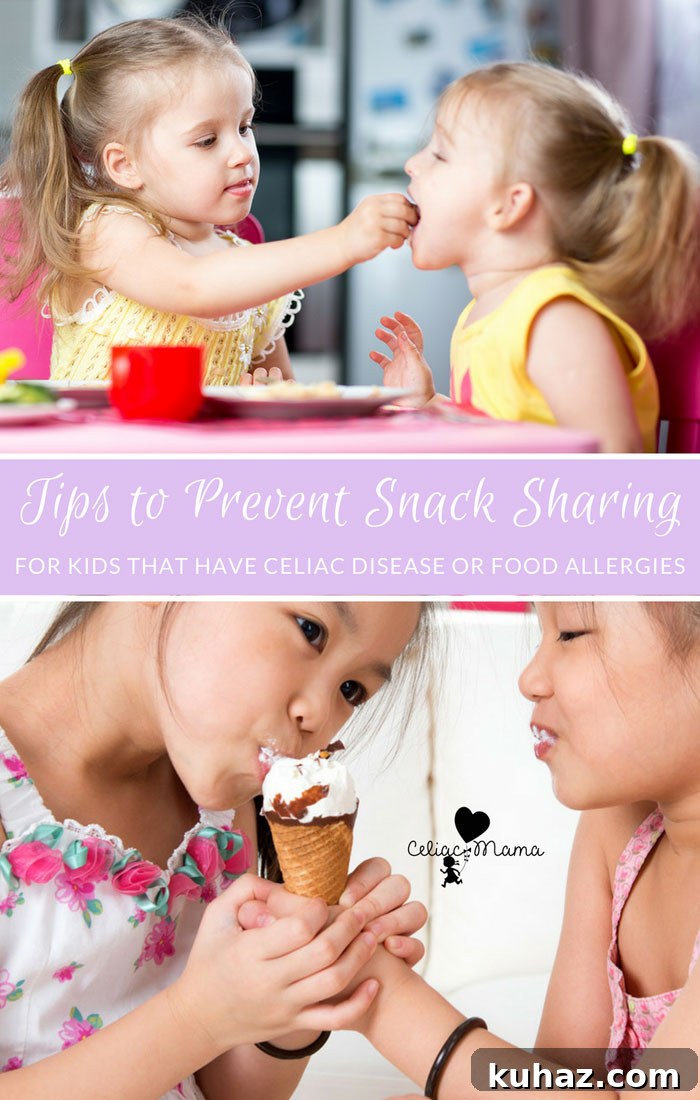
1. Role Playing – We practiced common scenarios through role play so our daughter could rehearse polite ways to refuse food. One adult would pretend to be a classmate offering a treat while the other coached responses. Practicing builds confidence and makes it easier for a child to act calmly in real situations.
Keep scripts simple and age-appropriate. Examples we used: “No, thank you. I can’t eat that,” or “Thanks, but that’s not mine to share.” For preschoolers, avoid explaining cross-contact or ingredient lists in detail—those concepts are confusing at that age. The key message is consistent: don’t share food. For older children you can add a short explanation like, “I have celiac disease and can’t eat wheat, so I don’t share food.” Role playing can also include how to redirect the conversation—offering a non-food way to be friendly, such as, “I’ll trade you a sticker instead,” or suggesting a shared activity like playing together after snack time.
2. Open Communication – From the first day of school we made it clear that if she saw something at school she really wanted to try, she should tell us and we would provide a safe alternative. Early on I checked in frequently: “What did everyone have today? Was there anything you’d like to try?” Initially she said no, but as she noticed friends enjoying burgers, chicken fingers, or cookies she began to tell us what she’d like.
Building a habit of honest communication reduces the chance a child will take a risk on their own. Encourage children to tell a teacher when a peer offers them food, and role play how to involve an adult if they feel pressured. Praise your child when they come to you instead of sneaking a bite—this reinforces trust and makes it more likely they’ll keep you informed about tempting situations.
3. Keep an Extra Supply of Snacks and Desserts at School – Having safe options on hand is vital. Between birthdays and holiday parties there are many opportunities for treats. We baked a dozen cupcakes—half chocolate, half vanilla—so our daughter could join celebrations and not feel left out. The teacher kept them in a freezer or a labeled container in the classroom so they were available when needed. If you know a party is scheduled, bringing a batch that matches what will be served is ideal, but surprises happen and a stocked stash covers unexpected events.
Work with your child’s teacher or school nurse to establish a routine for safe storage and clear labeling. Choose treats that can be easily stored and individually wrapped if possible, so they’re ready to hand out. If you prefer not to provide sweets, consider safe savory options or special small items that can be shared during celebrations as a non-food alternative.
Above all, be patient and compassionate. Children will test boundaries as they grow, and wanting to fit in is normal. With consistent rules, practice, and a reliable plan for safe alternatives, you can reduce risky moments and help your child participate socially without compromising their health. These strategies create a practical balance: protecting a child with celiac disease while supporting their social development and friendships.