You can read part 1 of Meghan’s birth story here.
When we first arrived in triage there was a quiet disappointment in the room; the staff suggested I might be sent home. After twelve hours of on-and-off contractions it was hard not to wonder whether I’d been through false labor, wasted energy on practice contractions, or simply started the beginning of a long labor.
A short while later a nurse returned with news from my doctor: because we lived thirty minutes away, he preferred that I stay. That decision felt like a small victory—relief that we weren’t being sent home and reassurance that my labor was being taken seriously.
Instead of going straight to a delivery room, I was asked to walk the hospital halls to encourage progression. Tim and I paced the large square loop, stopping every few minutes so I could lean forward and brace myself through each contraction. He held my hand, applied the breathing techniques we’d practiced in childbirth class, and coached me through the discomfort.
After more walking I was checked again and had dilated to four centimeters, so they admitted me. The nurse immediately asked whether I wanted an epidural. I said no—not yet. Though I had planned to have an epidural because I don’t tolerate pain well, in that moment the contractions, while uncomfortable, didn’t feel unbearable. I wanted to experience labor and avoid being numb too soon.
We spent some time in the room and then I took a long bath. The warm water helped me relax and manage the contractions better than I expected. I’d arrived at the hospital around 12:30 p.m., and after the tub it was likely after 4:00 p.m. The nurse then told me she’d spoken with my doctor and he recommended starting Pitocin.
I hadn’t discussed Pitocin ahead of time; I knew it was commonly used to induce labor, but I hadn’t realized it was sometimes given when labor was already underway to accelerate progress. Put on the spot and unsure about risks and benefits, I looked to Tim for guidance. He didn’t have an answer either. The nurse returned and emphasized that my doctor strongly recommended it to speed up labor, and reluctantly I agreed.
In hindsight I recognize there wasn’t a strictly medical necessity for Pitocin in my case—rather my doctor preferred not to wait until the middle of the night for delivery. At the time I wasn’t aware of all potential side effects. Once the Pitocin drip started I quickly noticed much stronger, closer contractions.
Shortly after the Pitocin began, the nurse warned that the anesthesiologist would soon be called into surgery and that I should get the epidural before the opportunity passed. Torn between wanting to wait and wanting pain relief, I decided to have the epidural so I wouldn’t be left without that option later. After it was placed I could see each contraction on the monitor yet didn’t feel the intensity. I rested and drifted off, grateful for sleep after being awake through the previous night.
Some time later I woke with a sudden rush—my water had broken and the bed was wet. The nurse checked me and announced I was nine centimeters dilated and would inform the doctor. She told me to call her when I felt pressure, because that would signal it was time to push.
Soon I began to feel pressure and discomfort, which I actually welcomed; it meant I could participate fully in the delivery. The doctor arrived and by about 9:00 p.m. it was time to push. Pushing felt like an athletic feat: intense, focused, and utterly exhausting. The team coached me to take a series of ten breaths and bear down, over and over. I’d run competitive 400-meter races in college, and pushing felt far harder than any race I’d run.
I experienced pain during the pushing phase—either the epidural had been partial or it was wearing off—but the sensation helped me gauge when to push and how to work with my body. At one point the nurse placed an oxygen mask on me because the baby’s oxygen levels were dipping, most likely related to the Pitocin-induced contractions. The mask made breathing awkward and I often wanted to remove it, but I kept it on for the baby’s sake.
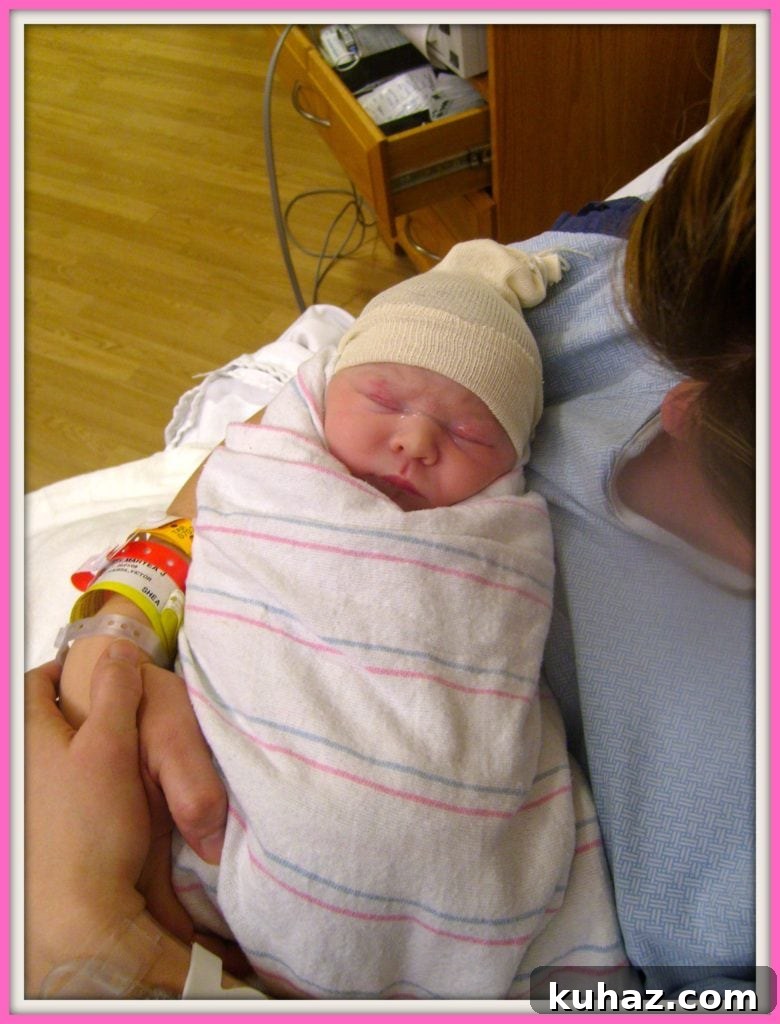
After twenty-five minutes of focused pushing, Meghan arrived at 9:25 p.m. I remember the fierce determination I felt once pushing began; the effort was relentless, and I can’t imagine having to sustain that for hours. It was the hardest physical thing I’ve ever done, but also one of the most rewarding.
Looking back there are a few choices I might change—especially about Pitocin—but I have no regrets about the end result. Meghan was born healthy and the birth, overall, was straightforward. It’s hard to hold onto regrets when you get to look at the face of your newborn.
Three years have passed, but the memory of the day Meghan was born remains vivid and will stay with me forever.